Menu Close

Category: archival community

Why Preserve? To Connect!

In honor of 2025’s World Digital Preservation Day (WDPD), I am finally taking a leap back into posting here. My last post was in February of 2020 – and while I can see a half-dozen partially written posts lurking behind the scenes, none of them were ever finished “enough” to actually post.

So… Happy World Digital Preservation Day! I just spent the last 4 days attending iPRES 2025 virtually. I was in Maryland while most of the attendees were in person on the other side of the planet in New Zealand. Luckily, I’m a night owl, so attending sessions from 3pm – 10:30pm my time was just fine with me.

The conference closed last night (still Wednesday) for me – but now I’ve caught up to Thursday November 6th and have the time to reflect on this year’s WDPD theme of “Why Preserve?”. Please keep in mind that the contents of this post, along with everything here on Spellbloundblog, reflect only my thoughts as an individual.

First, some context about me. I love stories and I love connection of all kinds – connections among people, connections between the past and all our possible futures, and connections that build community. Somewhere at their intersection is where I see the role for preservation. Without our digital records (preserved in such a way that they retain their context, can be trusted to be authentic, and can be interacted with in a meaningful way) we will lose stories of the past and all the evidence they contain. We will lose many kinds of connection.

Many communities have decided that this reason for preserving means that time, energy, and funding should be allocated toward this goal. One of iPRES 2025’s themes was Tūhono (Connect). This thread ran through keynotes, posters, bake-off demonstrations, and presentations/panels of all kinds. And for me – the theme of Tūhono elegantly ties into my understanding of “Why Preserve?”.

We preserve to connect. To connect the past to the future. To connect with both our professional digital preservation community and with those whose records are being preserved. Digging into my copious notes from the last few days, here are a few tidbits from iPRES 2025 that kept the focus on connection.

  • Late Sunday my time, I attended a workshop on Archival Resource Keys (ARKs). The ARK Alliance is a community that supports the ARK infrastructure. ARKs and the ARK Alliance are all about connection. ARKs are being used by libraries, archives, museums, government agencies, and more. From their website “ARKs are open, mainstream, non-paywalled, decentralized persistent identifiers that you can start creating in under 48 hours.” Want to connect your stuff to anyone who wants to refer to it in a durable way? ARKs can help.
  • Tuesday paper session 2 included a paper on “A Collaborative Framework for Migrations”, talking about digital preservation in Finland. The presenters highlighted that collaboration was key to success. Cultural institutions are experts in semantics and understanding while the digital preservation service is responsible for bit-level preservation, but you need both to ensure logical preservation. Without that collaboration, you can’t ensure the future usability of the information.
  • Wednesday’s keynote on “Encountering Collapse: Power, Community, and the Future of Open Infrastructure” was delivered by Rosalyn Metz, Chief Technology Officer for Libraries and Museum at Emory University. There were so many compelling elements to this talk, but I’ll share the one that spoke to me most strongly of connection. Community is the backbone of open infrastructure: “The resilience of infrastructure depends on the relationships that sustain it. Communities, not technologies, make infrastructure possible.”.
  • I spent pretty much all day Wednesday in the Bake-Offs, in which people demo tech tools and solutions. To my eye, it was a fantastic parade of people sharing. So many opportunities for speakers to literally demonstrate their expertise. I always love seeing what other folks are working on, especially open source projects that might be just the thing someone needs to move their own project forward. It’s like speed dating for future collaboration.
  • I saw many posters and lightening talks – but one that jumps out as fitting this theme was presented by Amy Pienta, Research Professor at ICPSR at University of Michigan. She spoke about the role of data stewards in safeguarding public data. DataLumos is a great example of a community coming together to ensure crucial resources are preserved. I’m glad that they exist, doing the work — and perhaps serving as inspiration for others to work on whatever challenges they find.
  • The closing keynote address from Peter-Lucas Jones, CEO of Te Hiku Media, specifically was tied to the conference theme of Connect. In order to understand traditional data, you must understand the importance of indigenous language. The efforts of Te Hiku Media include multiple ways of leveraging technology to both preserve the Māori language and give back to the community keeping the language alive (a few examples: teaching computers te reo Māori, creating a synthentic voice that can run on assistive devices and speaks te reo Māori, live bi-lingual captioning). He also emphasized that it was important to “empower communities to lead the change they need” – and that data licensing is key to prevent that what they are creating can only be used for purposes in sync with the communities wishes.
  • The last session I attended was Panel 7: “Working with ICT in Digital Preservation”. My connection thread from this panel discussion was the need for all of us to support one another as we navigate the multi-fold challenges to building the technical environments we need to preserve at-risk records. Yes, we do need to plug in old tech bought off ebay to see if it will work (and hope it won’t catch fire!). Yes, we need to leverage other teams’ success and use it as a “hey it worked for them” kind of argument to help us go around institutional rules that are keen on standardization. And yes – we need to connect with as many parts of our organizations to explain what digital preservation work is, how we do it, and why it is important.

This list is far from exhaustive, but I hope it gives you a taste of why the strongest thread for me from iPRES 2025 was connection. And why that is also my answer to “Why Preserve?”. To Connect.

PS: I’d like to thank the Web Hypertext Application Technology Working Group (WHATWG) who apparently created this fantastically useful named character reference list of all the character names that HTML recognizes so that I could appropriately publish two of the words I wanted to in this post accurately (Tūhono and Māori) via the WordPress text HTML interface. If you are curious, the answer to making the characters ū and ā display is preceding the strings umacr; and amacr; with an &. Yes, I needed the help of a community to share my ideas on connection.

THATCamp Reflections

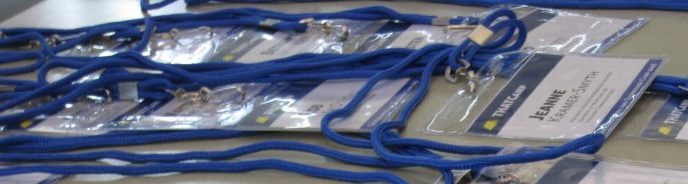
THATCamp 2008 Badges

My path to the inaugural THATCamp started at the Society of American Archivist’s 2006 annual meeting in DC. I was a local grad student presenting my first poster: Communicating Context in Online Collections – and handing out home-printed cards for my blog. When I ran out, I just wrote the URL on scraps of paper. I found my way to session 510: Archives Seminar: Possibilities and Problems of Digital History and Digital Collections, featuring Dan Cohen and Roy Rosenzweig, described in the SAA program as follows:

The co-authors of Digital History: A Guide to Gathering, Preserving, and Presenting the Past on the Web lead a discussion of their book and, in particular, the possibilities of digital history and of collecting the past online. The discussion includes reflections on the September 11 Digital Archive and the new Hurricane Digital Memory Bank, which collects stories, images, and other digital material related to hurricanes Katrina, Rita, and Wilma.

The full hour and twenty-four minutes audio recording is available online if you want to dive down that particular rabbit hole.

2006 was early in the “archives blogging” landscape. It was the era of finding and following like-minded colleagues. RSS and feed readers! People had conversations in the comments. 2006 was the year I launched my blog. My post about Dan & Roy’s session was only the 9th post on my site. I was employed full time doing Oracle database work at Discovery and working towards my MLS in the University of Maryland’s CLIS (now iSchool) program part-time. So I added Dan’s blog to the list of the blogs I read. When Dan invited people to come to THATCamp in January of 2008 and I realized it was local – I signed up. You can see my nametag in the “stack of badges” photo above. For a taste of my experiences that day, take a look at my 2008 THATCamp blog posts.

In 2008, the opportunity to sit in a room of people who were interested in the overlap of technology and humanities was exciting. As a part-time graduate student (and wife and mother of a 6-year-old), I spent almost no time on campus. I did most of my thinking about archives and technology at home late at night in the glow of my computer screen. There was not a lot of emphasis on the digital in my MLS program at UMD. I had to find that outside the classroom.

The connections I made at that first THATCamp extend to today. As mentioned elsewhere, I was part of the group who put together the first regional THATCamp in Austin as a one-evening side-event for the Society of American Archivists Annual Meeting in 2009. I swear that Ben Brumfield and I were just going to meet for dinner while I was in Austin, where he lives, for SAA. Somehow that turned into “Why not throw a THATCamp?”. How great to have no idea of the scale of what we were taking on! Ben did an amazing job of documenting what we learned and tips for future organizers, including giving yourself more time to plan, reaching out to as diverse a group as possible, and planning an event that lasted longer than four hours. All that said, it was a glorious and crazy evening. I still have my t-shirt. While our discussions might have been more archives-skewed than at most THATCamps, it also gave lots of archivists a taste of what THATCamp and un-conferences were like. Looking through the posts on the THATCamp Austin website, there was clearly an appetite for the event. We could easily have had enough topics to discuss to fill a weekend – but only had time for two one hour session slots, plus a speed round of “dork shorts” lightning talks.

I know I went to other THATCamps along the way. I graduated with my MLS in 2009. I started an actual day-job as an archivist in July of 2011 at the World Bank. Suddenly I got paid to think about archives all day – and I didn’t need my blog in the way I used to. I started writing more fiction and attending conferences dedicated to digital preservation. Somewhere in there, I went to the 2012 THATCamp Games at UMD.

THATCamps brought together enthusiastic people from so many different types of digital and humanities practice — all with their own perspectives and their own problems to solve. We don’t get many opportunities to cross-pollinate among those from academia and the public and private sectors. Those early conversations were my first steps towards ideas about how archivists might collaborate with professionals from other communities on digital challenges and innovations. In fact, I can see threads stretching from the very first THATCamp all the way to my Partners for Preservation book project.

Thanks, THATCamp community.

This post is cross-posted as part of the 2020 THATCamp retrospective.

Harnessing The Power of We: Transcription, Acquisition and Tagging

In honor of the Blog Action Day for 2012 and their theme of ‘The Power of We’, I would like to highlight a number of successful crowdsourced projects focused on transcribing, acquisition and tagging of archival materials. Nothing I can think of embodies ‘the power of we’ more clearly than the work being done by many hands from across the Internet.

Transcription

  • Old Weather Records: “Old Weather volunteers explore, mark, and transcribe historic ship’s logs from the 19th and early 20th centuries. We need your help because this task is impossible for computers, due to diverse and idiosyncratic handwriting that only human beings can read and understand effectively. By participating in Old Weather you’ll be helping advance research in multiple fields. Data about past weather and sea-ice conditions are vital for climate scientists, while historians value knowing about the course of a voyage and the events that transpired. Since many of these logs haven’t been examined since they were originally filled in by a mariner long ago you might even discover something surprising.”
  • From The Page: “FromThePage is free software that allows volunteers to transcribe handwritten documents on-line.” A number of different projects are using this software including: The San Diego Museum of Natural History’s project to transcribe the field notes of herpetologist Laurence M. Klaube and Southwestern University’s project to transcribe the Mexican War Diary of Zenas Matthews.
  • National Archives Transcription: as part of the National Archives Citizen Archivist program, individuals have the opportunity to transcribe a variety of records. As described on the transcription home page: “letters to a civil war spy, presidential records, suffrage petitions, and fugitive slave case files”.

Acquisition:

  • Archive Team: The ArchiveTeam describes itself as “a rogue archivist collective dedicated to saving copies of rapidly dying or deleted websites for the sake of history and digital heritage.” Here is an example of the information gathered, shared and collaborated on by the ArchiveTeam focused on saving content from Friendster. The rescued data is (whenever possible) uploaded in the Internet Archive and can be found here:

    Springing into action, Archive Team began mirroring Friendster accounts, downloading all relevant data and archiving it, focusing on the first 2-3 years of Friendster’s existence (for historical purposes and study) as well as samples scattered throughout the site’s history – in all, roughly 20 million of the 112 million accounts of Friendster were mirrored before the site rebooted.

Tagging:

  • National Archives Tagging: another part of the Citizen Archivist project encourages tagging of a variety of records, including images of the Titanic, architectural drawings of lighthouses and the Petition Against the Annexation of Hawaii from 1898.
  • Flickr Commons: throughout the Flickr Commons, archives and other cultural heritage institutions encourage tagging of images

These are just a taste of the crowdsourced efforts currently being experimented with across the internet. Did I miss your favorite? Please add it below!

Heading to Austin for SXSW Interactive

Anyone out there going to be at SXSWi? I would love to find like-minded DH (digital humanities) and GLAM (Galleries, Libraries, Archives & Museums) folks in Austin. If you can’t go, what do you wish I would attend and blog about after the fact?

No promises on thoroughness of my blogging of course. I never have mastered the ‘live blogging’ approach, but I do enjoy taking notes and if the past is any guide to the future I usually manage at least 2 really detailed posts on sessions from any one conference. The rest end up being notes to myself that I always mean to somehow go back to and post later. Maybe I need to spend a month just cleaning up and posting old session summaries (or at least those that still seem interesting and relevant!).

Drop me a comment below or contact me directly and let me know if you will be in Austin between March 10 and 15. Hope to see some of you there!

ArchivesZ Needs You!

I got a kind email today asking “Whither ArchivesZ?”. My reply was: “it is sleeping” (projects do need their rest) and “I just started a new job” (I am now a Metadata and Taxonomy Consultant at The World Bank) and “I need to find enthusiastic people to help me”. That final point brings me to this post.

I find myself in the odd position of having finished my Master’s Degree and not wanting to sign on for the long haul of a PhD. So I have a big project that was born in academia, initially as a joint class project and more recently as independent research with a grant-funded programmer, but I am no longer in academia.

What happens to projects like ArchivesZ? Is there an evolutionary path towards it being a collaborative project among dispersed enthusiastic individuals? Or am I more likely to succeed by recruiting current graduate students at my former (and still nearby) institution? I have discussed this one-on-one with a number of individuals, but I haven’t thrown open the gates for those who follow me here online.

For those of you who have been waiting patiently, the ArchivesZ version 2 prototype is avaiable online. I can’t promise it will stay online for long – it is definitely brittle for reasons I haven’t totally identified. A few things to be aware of:

  • when you load the main page, you should see tags listed at the bottom – if you don’t at all, then drop me an email via my contact form and I will try and get Tomcat and Solr back up. If you have a small screen – you may need to view your browser full screen to get to all the parts of the UI.
  • I know there are lots of bugs of various sizes. Some paths through the app work – some don’t. Some screens are just placeholders. Feel free to poke around and try things – you can’t break it for anyone else!

I think there are a few key challenges to building what I would think of as the first ‘full’ version of ArchivesZ – listed here in no particular order:

  • In the process of creating version 2, I was too ambitious. The current version of ArchivesZ has lots of issues, some usability – some bugs (see prototype above!)
  • Wherever a collaborative workspace of ArchivesZ were going to live, it would need large data sets. I did a lot of work on data from eleven institutions in the spring of 2009, so there is a lot of data available – but it is still a challenge.
  • A lot of my future ideas for ArchivesZ are trapped in my head. The good news is that I am honestly open to others’ ideas for where to take it in the future.
  • How do we build a community around the creation of ArchivesZ?

I still feel that there is a lot to be gained by building a centralized visualization tool/service through which researchers and archivists could explore and discover archival materials. I even think there is promise to a freestanding tool that supports exploration of materials within a single institution. I can’t build it alone. This is a good thing – it will be a much better in the end with the input, energy and knowledge of others. I am good at ideas and good at playing the devil’s advocate. I have lots of strength on the data side of things and visualization has been a passion of mine for years. I need smart people with new ideas, strong tech skills (or a desire to learn) and people who can figure out how to organize the herd of cats I hope to recruit.

So – what can you do to help ArchivesZ? Do you have mad Action Script 3 skills? Do you want to dig into the scary little ruby script that populates the database? Maybe you prefer to organize and coordinate? You have always wanted to figure out how a project like this could group from a happy (or awkward?) prototype into a real service that people depend on?

Do you have a vision for how to tackle this as a project? Open source? Grant funded? Something else clever?

Know any graduate students looking for good research topics? There are juicy bits here for those interested in data, classification, visualization and cross-repository search.

I will be at SAA in DC in August chairing a panel on search engine optimization of archival websites. If there is even just one of you out there who is interested, I would cheerfully organize an ArchivesZ summit of some sort in which I could show folks the good, bad and ugly of the prototype as it stands. Let me know in the comments below.

Won’t be at SAA but want to help? Chime in here too. I am happy to set up some shared desktop tours of whatever you would like to see.

PS: Yes, I do have all the version 2 code – and what is online at the Google Code ArchivesZ page is not up to date. Updating the ArchivesZ website and uploading the current code is on my to do list!

Interactive Archivist: Spellbound Blog as a Case Study

I realized while at MARAC at the end of October that I never posted here about the completion and publication of the Interactive Archivist: Case Studies in Utilizing Web 2.0 to Improve the Archival Experience. The brainchild of J. Gordon Daines III and Cory Nimer, this free SAA ePublication only exists online and brings together ten Web 2.0 archivist-oriented case studies covering blogs, mashups, tagging, wikis, Facebook and more. It also includes thorough introductions to each of the technologies covered by case studies, an annotated bibliography and a link to a living list of resources on Delicious.

My contribution to the collection is titled Spellbound Blog: Using Blogs as a Professional Development Opportunity. I don’t spend much time on this blog talking about blogging, so if you ever wanted to know more about why I blog or are considering starting a blog yourself – my case study might be of interest.

Thank you again to Gordon and Cory for including me as part of their project. I think that it is a great contribution to the cultural heritage community at large. These case studies take a wide range of new technologies and make them accessible through real examples and lessons learned. I don’t know about you, but I believe I learn at least 10x as much from someone’s first hand experience than I would from an abstracted explanation of how one might use a new technology. I hope you find the Interactive Archivist as rich a resource as I believe you will.

A History of Our Own, Representing Communities and Identities on the Web (SAA09: Session 202)

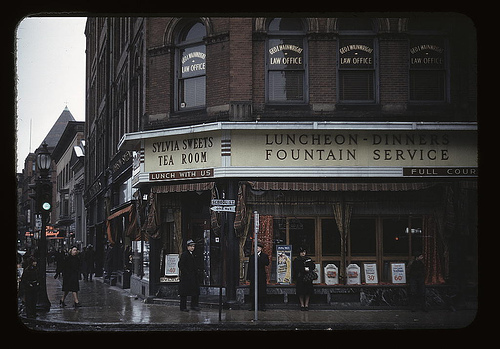
LOC Flickr Commons: Sylvia Sweets Tea RoomAndrew Flinn, University College London (UCL), was the second speaker during SAA09’s Session 202 with his presentation ‘A History of Our Own, Representing Communities and Identities on the Web’. Flinn began with the idea that archives are “a place for creating and re-working memory”. While independent community archives are constituted around many purposes, Flinn’s main interest is in communities focused on absences and mis-representation of a group or event in history. Communities in which there is a cultural, politcal, or artistic activism. Some of these communities may be considered ‘movements’.

How should/can archivists support local archiving activities?

Part of the challenge of online communities is the need to capture the interactions in order to not loose the full picture. The National Listing of Community Archives in the UK‘s website states that they “seek to document the history of all manner of local, occupations, ethnic, faith and other diverse communities”.

The UCL’s International Centre for Archives and Records Management Research and User Studies (ICARUS) “brings together researchers in user access and description, community archives and identity, concepts and contexts of records and archives, and information policy”. Flinn is the Principal Investigator on the ICARUS project Community archives and identities which focuses on in depth interviews of 4 institutions which are “documenting and sustaining community heritage”.

These are some example online community sites:

Main Findings

  • proceed from a position that ‘knowing your own history’ is beneficial their communities as well as to the public at large
  • the quality of the work is done by individual passion and sacrifice, voluntary
  • there is ambivalence to/about the mainstream archives sector — keen to work with mainstream archives, but scarred by past bad experiences
  • good practices now could lead to partnerships in the future
  • these are living archives — not static.. still alive and growing
  • these ideas prompt re-evaluation of conventional archives thinking
  • lots of access to digital objects – perhaps movement to online existence

We need to understand that these communities evolve and are fluid. They have as broad variety of structures, sizes and methods of working. What are the patterns in participation & ownership?

The site urban 75 has hosted extended discussions about recent UK history. Efforts include identification of places and people in uploaded photos. The site connects people about issues about housing and local services – it is very practical but it also has evolved to include this historical documentation. One example post from the Brixton Forum shows a discussion about an Old shop front revealed on Atlantic Road.

A Short Aside

Next Flinn apologized for taking his talk slightly off script. Setting his papers aside, he spoke to the audience about the eXHulme website which he had discovered the evening before while finishing his presentation. Having lived in Hulme, Manchester himself, he felt a great impact from looking through the site. He spent 4 hours looking at it – including photos such as the travellers living in their buses parked – otteburn close 1996 seen at the bottom of this page. His discovery and exploration of this site gave him a greater personal understanding of the impact of these types of community documentation projects. I felt he would have been happy to keep talking about this site and the directions it had sent his thoughts — but he then got back to his papers and continued.

Building Community Online

Interactions online are the historic record of the community itself. Archives evolve and change as the community builds and edits their online content. These heritage and archive sites work to shift from the idea of visitors to engaging users in interaction — they need users of the website to feel part of the community.

Examples of sites building community online:

How do you successfully encourage participation (rather than large number of passive observers) which is crucial to the success of these types of initiatives? Lurking without contributing is easy – even if joining requires action. The rate of uptake may correspond with the sense of ownership. Heritage projects might encourage and sustain such participation. See Elisa Giaccardi & Leysia Palen’s article  – The Social Production of Heritage through Cross-media Interaction: Making Place for Place-making.

Suggestions

  • encourage conversation and treat all stories as having value – value every account
  • promote a sense of ownership once a story has been shared
  • allow for multiple ways to engage with and share content and memories
  • recognize and let users shift from observer to active member

Flinn’s Conclusions

  • What are the challenges and perils facing community archives? Lack of resources. People are doing these things in unsustainable ways
  • Why should we sustain independent community archives? Benefit to individuals, communities and broader society.
  • What can professional archivists do? Support and partnership with groups seeking this sort of partnership.

My Thoughts

The image I included above is from the Library of Congress’s Flickr Commons project. If you read through the comments on this photo you can see a diverse group of individuals come together to document the history of Sylvia Sweets Tea Room. This is just another example of the process of documentation being as interesting as the original image itself.

There is still so much to learn in the arena of building productive online communities. Archivists working through how to archive what online communities create will need to understand how the process of creation is documented via various software tools. As the techniques for encouraging participation evolve – archivists will need to evolve right along with them. I think it is interesting to envision archivists working in this space and supporting these types of communities — becoming as much the champions of the community itself as preservers of a community’s collaborative creations.

Image Credit: Flickr Commons Library of Congress: Sylvia Sweets Tea Room, corner of School and Main streets, Brockton, Mass

As is the case with all my session summaries from SAA2009, please accept my apologies in advance for any cases in which I misquote, overly simplify or miss points altogether in the post above. These sessions move fast and my main goal is to capture the core of the ideas presented and exchanged. Feel free to contact me about corrections to my summary either via comments on this post or via my contact form.

Archival Collections Online: Reaching Audiences Beyond The Edge of Campus (SAA09: Session 405)

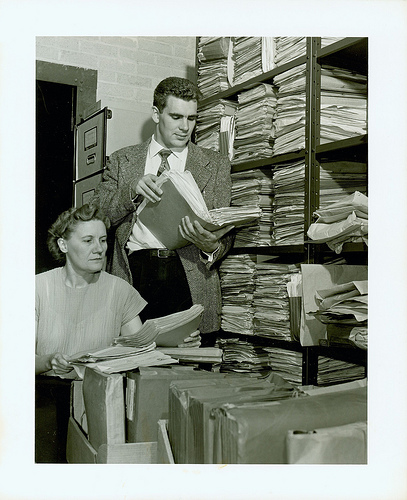
The Archivist's Life, 23 May 1954Expanding Your Local and Global Audiences (Session 405, SAA 2009) shared how three institutions of higher education are using the web to reach out to new audiences. While the general public may still hold close the stereotype of archives as of rooms full of boxes of paper (not so different from this Duke image on Flickr: “Mattie Russell, curator of manuscripts, and Jay Luvaas, director of the Flowers Collection, examine the papers of Senator Willis Smith in the library vault.”), the presenters in this session are focused on expanding peoples’ experience of archives beyond boxes of papers locked away in a vault. They are using the web as a tool to reach beyond the walls of their reading rooms and the edges of their campuses.

Duke University Rare Books, Manuscript & Special Collections Library (RBMSCL) : Lynn Eaton (Reference Archivist)

While I didn’t find my way into this session until the start of the next speaker’s presentation, Lynn was kind enough to share with me her personal printout of her presentation slides. The links below and any associated commentary are based solely on my own interpretation of the various screen-shots included.

University of Nevada Las Vegas (UNLV) Digital Collections: Tom Sommer (University and Technical Services Archivist)

UNLV has experimented with new technologies as they appear. Tom made a point of saying that when they started seeing others provide a feature on their websites, UNLV would find a way to try it out. A great example of this is the addition of a tag cloud and google map to The Boomtown Years collection listed below.

Marist College Archives and Special Collections: John Ansley (Head, Archives and Special Collections)

Marist first launched their website in 2001 to raise awareness of their collections. They also used listserves and the on-campus newspaper. Utlimately their best tactic was working one-on-one with professors whose interests intersected with their collections. This led to contact with special interest groups. Working with the special interest groups led to new tag and metadata values for their collections.

My Thoughts

The archivists at all three of these educational institutions have tried new things and worked hard to share their materials with people beyond the traditional range of a reading room. The promise of the web, and all the tools and techniques it supports, is still being uncovered. It will be up to innovative archivists to keep discovering ways to push the envelope and welcome new audiences from all the corners of the globe.

Image Credit: http://www.flickr.com/photos/dukeyearlook/ / CC BY-NC-SA 2.0

As is the case with all my session summaries from SAA2009, please accept my apologies in advance for any cases in which I misquote, overly simplify or miss points altogether in the post above. These sessions move fast and my main goal is to capture the core of the ideas presented and exchanged. Feel free to contact me about corrections to my summary either via comments on this post or via my contact form.

SAA09: My Session on Online Communities (Session 101)

Thank you to everyone who came to our session this morning (Building, Managing, and Participating in Online Communities: Avoiding Culture Shock Online). Word on the street is that we had about 150 people in the audience.

As I mentioned during our talk – here is the Online Communities Comparison Chart. Please let me know if you have any issues accessing this document and feel free to share it with anyone you like.

If you had questions you were unable to ask during the session – please feel free to post them as comments below or send me a message via my  Contact Form. I will be sure to pass questions along to all the members of our panel. I also plan to update this post with links to everyone’s slides as they appear online.

Slides from our talk:

SAA has posted video of our presentation on facebook. The one I have linked to is the first of 7 segments. To view each in order, keep clicking ‘previous’ to view the next video.

Blog L’Archivista has a great post about our session.